
Weight Loss · Metabolic care

GLP-1 weight care, built for midlife.

Most weight-loss telehealth treats every body the same. Cypress is built around women navigating midlife — where hormones, sleep, and metabolism all shift together. Weight is often the change that's hardest to ignore. We start there, then look at the rest.

Start your assessment

3-minute medical screener · Plans from $179 first month · 100% confidential.

Woman in midlife considering weight care options

Simple, transparent pricing.

Three paths to GLP-1 care. Monthly billing, no upfront commitment. Your clinician confirms which option fits your medical history before anything ships.

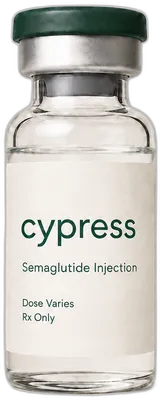
Semaglutide
Injections or drops
From
$179/month
Most common
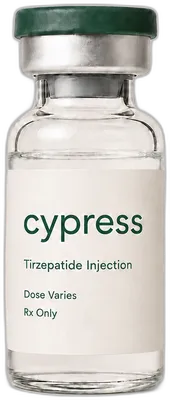
Tirzepatide
Injections or drops
From
$229/month
Stronger results
Branded options
Insurance-covered medications
 
Insurance based
If eligible
See if I'm eligible
No commitment, 100% confidential
A note on compounded GLP-1
Compounded medications are dispensed by state-licensed pharmacies in FDA-regulated facilities, but they are not FDA-approved. They are prescribed under the patient-specific 503A exception and made for you, by name, by a licensed prescriber. We are watching FDA guidance closely and will keep you informed of any changes that affect your plan.

What is GLP-1

A hormone-based path, not a willpower test.

A quiet moment — the steady ease of hormone-led weight care

GLP-1 is a hormone your body already makes. It's released after eating to signal fullness, slow digestion, and steady blood sugar. In midlife, the way your body uses GLP-1 can shift — and so can the result.

GLP-1 receptor agonist medications support that signal. The result, for many women: appetite quiets, cravings ease, and weight responds to small, sustainable changes — the kind that don't require white-knuckling through your day.

Whether GLP-1 is right for you depends on your medical history, your current health, and your goals. Your clinician will determine that. The intake is the first step.

Three steps. Roughly three minutes.

1
Medical screener
A focused intake covering history, current health, and what you've tried. Built specifically for women in midlife — we ask about hormones, sleep, and stress alongside the standard questions.
2
Clinician review
An independent licensed clinician reviews your assessment, typically within 24 hours, and determines whether GLP-1 therapy is appropriate — and which option fits.
3
Direct-to-door
If approved, your medication ships discreetly. You get ongoing clinician oversight, dose adjustment, and side-effect support — all included in your plan.

Three things that don't change.

The medicine is well-studied

Semaglutide and tirzepatide are the most-studied molecules in modern weight care. STEP 11 showed an average ~14.9% body weight loss with semaglutide over 68 weeks; SURMOUNT-12 showed up to ~20.9% with tirzepatide over 72 weeks. Outcomes from branded clinical trials cannot be directly attributed to compounded preparations — but the active ingredients are the same.3

U.S.-licensed clinicians, end-to-end

Your care is overseen by independent U.S.-licensed clinicians with experience in women's metabolic health. They review your assessment, set your starting dose, adjust as you go, and stay available through your plan — not just at the start. HIPAA-compliant infrastructure, U.S.-based 503A partner pharmacies.4

Built for midlife

We built Cypress because women navigating perimenopause and midlife metabolic shifts kept telling us the same thing: general telehealth treats every body the same. Hormone-aware metabolic care is its own discipline.5 We're starting with the basics done right — and adding the rest as we go.

Questions

Answers to
common questions.

How is compounded GLP-1 different from Ozempic, Wegovy, Mounjaro, or Zepbound?
Same active ingredients, prepared per-patient under the 503A exception — not FDA-approved as finished products.
Ozempic, Wegovy, Mounjaro, and Zepbound are FDA-approved branded GLP-1 medications manufactured by Novo Nordisk (semaglutide) and Eli Lilly (tirzepatide). Compounded GLP-1 is prepared per-patient by a state-licensed U.S. pharmacy under the 503A exception — the same active ingredient as the branded versions, but not FDA-approved as a finished product. Branded options are insurance-reimbursable; compounded plans are cash-pay. Your clinician helps you decide which path fits your medical history, goals, and budget.
When am I charged?
Not until a clinician confirms your eligibility — typically within 24–48 hours.
You're not charged when you submit your assessment. Your card is securely saved while a licensed clinician reviews your case, typically within 24 to 48 hours. If you're approved, you'll receive an email confirmation before any charge. If you're not approved, you're not charged at all.
What's included in my plan?
Medication, expedited shipping, your clinician consultation, and ongoing oversight.
Your plan includes prescription medication (compounded by a state-licensed U.S. pharmacy), expedited shipping with tracking, your initial clinician consultation, ongoing clinician oversight throughout your plan, dose adjustments, and side-effect support. Branded plans cover the consultation and clinician care; the medication itself is dispensed through your insurance.
Can I cancel?
Cancel anytime on monthly. 6 and 12-month plans are committed terms with lower per-month pricing.
The 1-month plan can be cancelled at any time. The 6 and 12-month plans are committed terms billed monthly — you can cancel future renewals after the term ends. The committed terms unlock lower per-month pricing in exchange for the duration commitment.
How long does shipping take?
1–2 business days to ship; cold-chain delivery for injectable formats.
Once your clinician approves your plan, the pharmacy ships within 1–2 business days via UPS or FedEx, Monday through Friday. Cold-chain shipping for injectable medications is two-day in cooler months and overnight when temperatures are warm; sublingual drops ship two-day. Refrigerate on arrival per the storage instructions included with your shipment. If a shipment is lost or arrives damaged, we'll reship at no cost.
Will my insurance reimburse this? Can I use HSA or FSA?
Branded GLP-1 plans are insurance-reimbursable; compounded plans are cash-pay.
Compounded GLP-1 medications are generally not insurance-reimbursable because they're prepared per-patient rather than as FDA-approved finished products. Branded GLP-1 plans are designed to be paid up front and self-reimbursed via your insurance — your clinician's office can help with documentation. HSA or FSA cards are typically accepted for prescription medications; check with your benefits administrator to confirm eligibility for compounded medications under your specific plan.
U.S.-licensed clinicians
State-licensed 503A pharmacies
HIPAA-compliant
Free shipping included
Ongoing clinician care

Ready to see your options?

The 3-minute screener is free. If you're a candidate, your clinician follows up within 24 hours.

Take the assessment

References

  1. 1 Wilding JPH, Batterham RL, Calanna S, et al. Once-Weekly Semaglutide in Adults with Overweight or Obesity (STEP 1). New England Journal of Medicine. 2021;384(11):989–1002. nejm.org/doi/full/10.1056/NEJMoa2032183
  2. 2 Jastreboff AM, Aronne LJ, Ahmad NN, et al. Tirzepatide Once Weekly for the Treatment of Obesity (SURMOUNT-1). New England Journal of Medicine. 2022;387(3):205–216. nejm.org/doi/full/10.1056/NEJMoa2206038
  3. 3 U.S. Food & Drug Administration. Compounding and the FDA: Questions and Answers. Compounded drugs are prepared per-patient by state-licensed pharmacies under sections 503A/503B of the Federal Food, Drug, and Cosmetic Act and are not FDA-approved as finished products. fda.gov/drugs/human-drug-compounding
  4. 4 U.S. Department of Health & Human Services. HIPAA Privacy Rule, 45 CFR Part 160 and Subparts A and E of Part 164. hhs.gov/hipaa
  5. 5 Davis SR, Castelo-Branco C, Chedraui P, et al. Understanding weight gain at menopause. Climacteric. 2012;15(5):419–429; Greendale GA, Sternfeld B, Huang M, et al. Changes in body composition and weight during the menopause transition. JCI Insight. 2019;4(5):e124865. ncbi.nlm.nih.gov/pmc/articles/PMC6483504